LumeraOne JournalLast reviewed November 22, 2026
The Wobbly Stage: What Parents Should Know About Bumps, Falls and Soft Head Caps
A calm, sourced guide to baby head bumps: why they happen, what pediatric sources say to watch for, and where a soft head cap honestly fits. Written by the LumeraOne team.
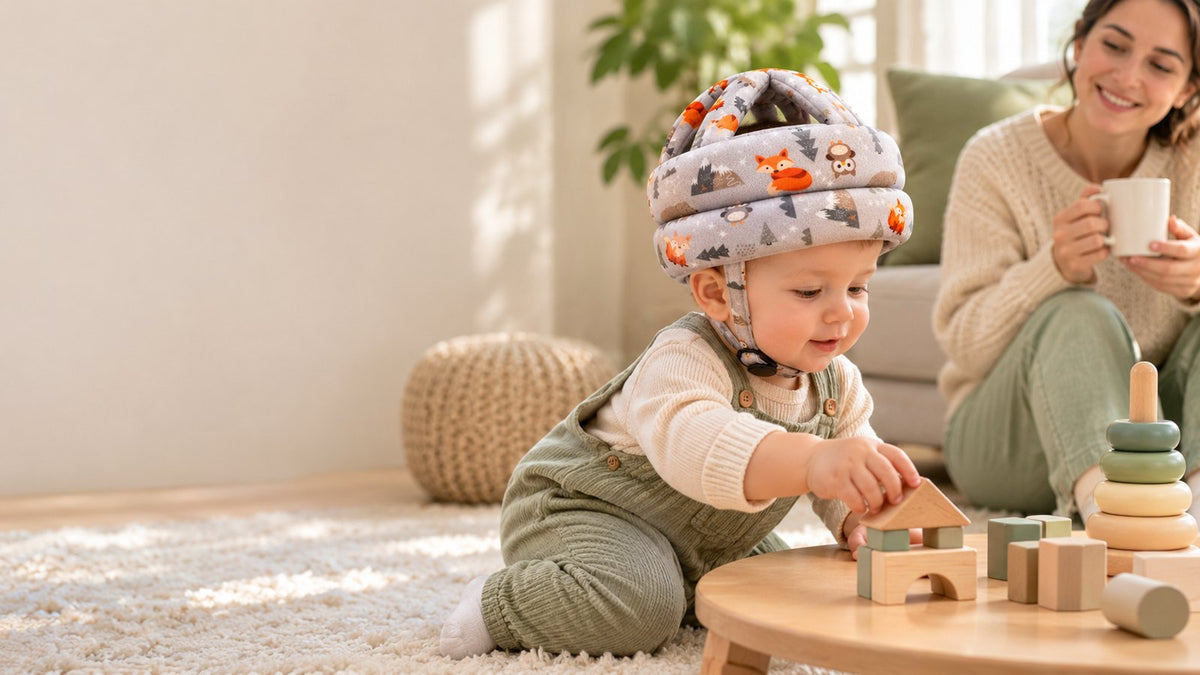
There is a stage when pulling up becomes part of every day. The couch turns into a practice bar, the coffee table into a landmark, and the whole living room into a place to explore. It is wonderful to watch, and it comes with a lot of wobbling.
Bumps are a normal part of learning to walk. Most are over in a minute, with a cuddle. But as a parent you may also wonder what actually happens when a baby hits their head, when it matters, and whether a soft head cap is worth considering. This guide covers all of it: what the pediatric sources say, what to watch for, and where our Soft Baby Head Protector honestly fits, including what it does not do.
Why the wobbly stage is bumpy
Babies and toddlers are built differently from older children. According to the American Academy of Pediatrics (AAP), their heads are large compared with their bodies, which makes them top-heavy. Their neck muscles are still developing, so they have less control over how the head moves. And when they lose their balance while learning to walk, run and climb, they are more likely than an older child to fall headfirst. AAP, HealthyChildren.org
None of this means something is wrong. It is simply why the crawling, cruising and first-steps stage comes with so many small tumbles.
How common are bumps and falls?
Very common. The AAP notes that almost all children bump their heads now and then, and that most head injuries are minor and do not cause lasting problems. AAP. Rhode Island's health department, summarizing national figures, says falls are the most common cause of non-fatal injuries in children, that most falls are harmless, and that children under five account for roughly 1.2 million emergency room visits a year in the US for fall-related injuries. RI Department of Health
A CDC-published study of children aged 0 to 4 found that falls are the leading cause of traumatic brain injury (TBI) in that age group. CDC study abstract Lurie Children's Hospital similarly reports that children under 4 have the highest rates of TBI of any age group, with falls at home as the leading cause. Lurie Children's
Most of those are minor. But these numbers explain why pediatric organizations take head impacts seriously, even though the typical living-room tumble is harmless.
Why a hit to the head deserves a second look
A concussion is a mild traumatic brain injury. The AAP explains that a bump, blow or jolt makes the head move quickly back and forth, which can briefly disrupt normal brain function. Any impact hard enough to jolt the head or body can cause one, not only falls. AAP
Two things make this tricky with little ones. First, babies cannot tell you how they feel. Second, the CDC points out that signs may not show up right away; they can take hours or even days to appear. CDC HEADS UP
The CDC also notes that most children with a concussion feel better within a few weeks, and the AAP adds that very young children can take longer to recover than older ones. That is why it helps to know what to watch for.
What to watch for after a bump (birth to age 4)
The CDC lists these as possible signs of a concussion in infants, toddlers and preschoolers:
- Crying and irritability more than usual
- Wanting extra comfort, such as being held more
- Refusing to nurse or eat
- Sleeping more or less than normal
- Losing interest in play or usual activities
- More tantrums, sadness or irritability
- Slower speech
- Vomiting right after the injury with no other cause
- Seeming dazed or confused, clumsier than usual, or unsteady on their feet
Go to the emergency room or call 911 straight away if, after a bump, blow or jolt to the head, your child has any of the danger signs the CDC and AAP list, including:
- Loss of consciousness, even briefly
- A seizure or convulsions
- Repeated vomiting
- Crying that will not stop and cannot be soothed (infants)
- Refusing to nurse or eat (infants)
- Unusual drowsiness or trouble waking up
- One pupil larger than the other
- Slurred speech, weakness or poor coordination
- Behavior that is very unlike your child
The AAP also suggests calling your child's doctor for anything more than a light bump. Its general guidance for minor head bumps is not written for children under 2, so for babies and young toddlers, call your pediatrician rather than trying to judge it at home. AAP This article is general information, not medical advice. If you are worried about your child, trust your instincts and contact a medical professional.
What pediatric sources recommend first
The AAP's steps to reduce the chance of a head injury in babies and young children are mostly about the environment:
- Use baby gates at the top and bottom of stairs, and childproof windows and bathrooms
- Keep a hand on your child whenever they are on furniture, including a changing table
- Anchor heavy furniture, such as dressers, to the wall
- Always buckle your child correctly in a car safety seat
- Choose playground equipment that suits your child's age
Pediatrician Dr. Adam Davis, writing for ParentData, suggests making the space softer, for example with rugs and play mats, and using gates where a fall could be more serious. ParentData
These come first, and a soft cap does not replace any of them.
Where a soft head cap fits, honestly
Here is what we think you deserve to hear. Some pediatric voices are skeptical about head protectors for babies. Dr. Davis writes that falls at the learning-to-walk stage are short and slow, that there is no evidence routine bumps from learning to walk cause long-term harm, and that wearing helmets during walking practice has not been studied. He advises against helmets for this stage. ParentData
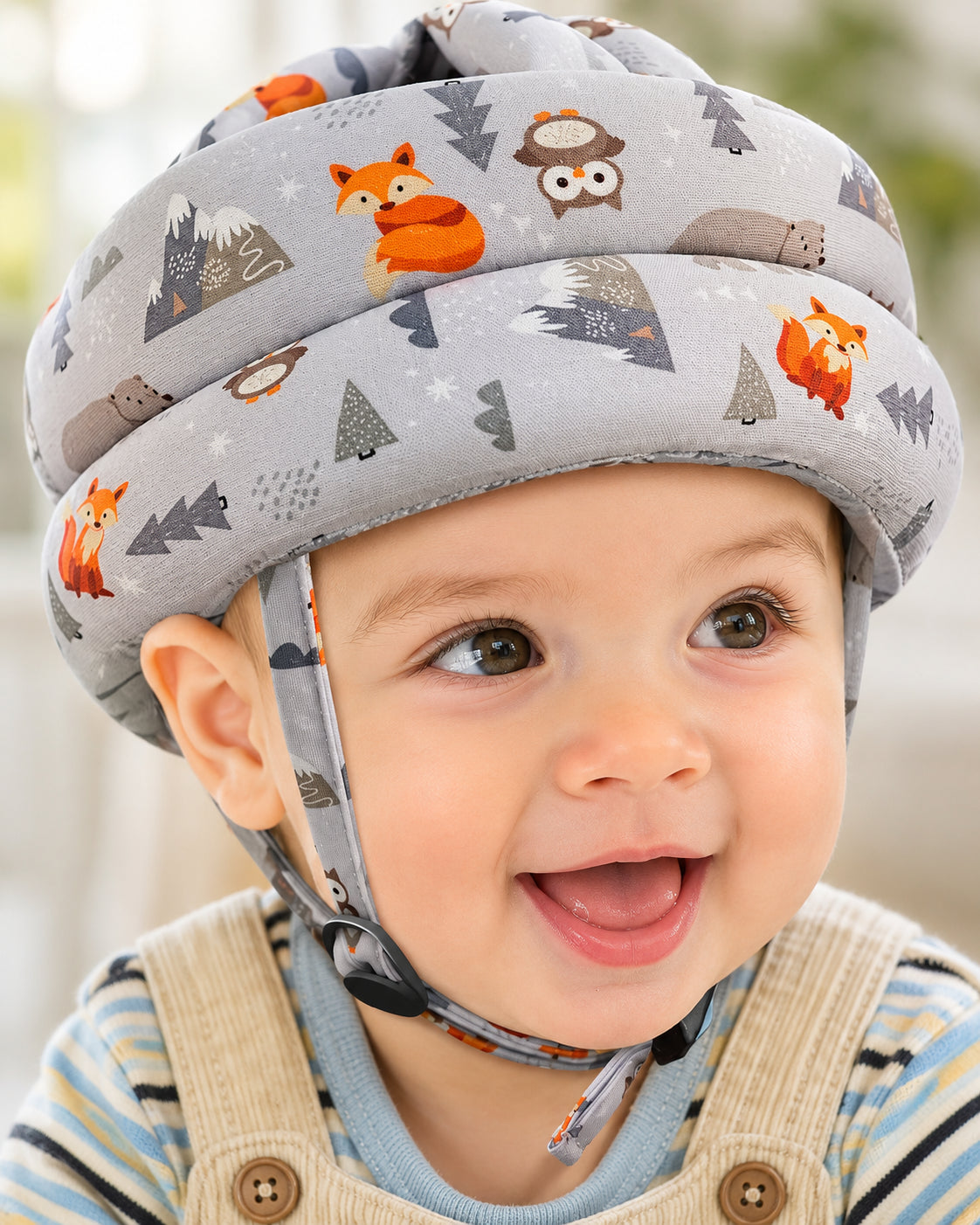
We are not going to argue with that, and we are not going to promise that our cap prevents concussions or any other injury, because we cannot. What we can tell you is what it is: a soft, flexible cap with foam padding at the front, sides and back of the head, designed to add a layer of cushioning around the areas it covers during awake, supervised play. For some parents that is simply a bit of added peace of mind during a wobbly few months, and for others it is not something they want. Both are reasonable choices.
If you are unsure, ask your pediatrician. They know your baby.
What the Soft Baby Head Protector is
It is a soft, flexible cap with foam padding and a lightweight, breathable polyester cover. There is no hard shell. Here is what you get:
- Padding at the front (forehead), the sides and the back of the head
- Soft foam padding with a breathable polyester cover, and no hard shell
- Two-point adjustment: a rear hook-and-loop panel and an under-chin Y-strap with a buckle
- Fits head circumference 16.5 to 19 in (42 to 48 cm)
- Machine washable (follow the care label for wash and dry settings)
What it will not do
- It does not guarantee injury prevention, and it is not proven to prevent concussions.
- It is not a substitute for adult supervision or for a baby-proofed home.
- It is for awake, supervised play only. Remove it before sleep and any time your baby is not being watched.
- It does not cover the face or neck.
- It is not a medical device, and it is not a bicycle or sports helmet.
We would rather you know this before you buy than after.
If you decide to try one
- Use it only while your baby is awake and an adult is close by.
- Introduce it gradually. Let your baby look at it and touch it first, and start with short sessions.
- Make sure it sits comfortably and the chin strap is snug but not tight.
- Take it off if your baby seems uncomfortable or warm, and give breaks.
- Take it off before sleep, naps and car rides where your baby may doze off.
- Keep the rest of the safety basics in place: gates, soft surfaces, anchored furniture.
Some babies simply do not like wearing anything on their head. If yours pulls it off, that is useful information, not a failure. Comfort matters more than wear time.
Safety, materials and documentation
Children's products sold in the United States are expected to meet federal safety requirements, and it is fair to ask any seller about them. The cap is made of soft foam padding with a breathable polyester cover, with no hard shell.
If you would like to know more about the materials, or have a question about product safety documentation, email us at dvecom7@gmail.com and we will get back to you.
Is it right for your family?
It may be a good fit if your baby is crawling, pulling up or taking early steps, you are close by during play, and you would like a soft layer on the head during this stage. If your baby seems uncomfortable or warm, take the cap off.
It may not be for you if your baby does not tolerate wearing it, if you prefer to rely on a baby-proofed space alone, or if you were hoping for something to use during sleep or while no one is watching. If you have questions about your baby's development, or whether any headwear is suitable for them, your pediatrician is the right person to ask.
Try it with a 60-day guarantee
Every order is backed by our 60-day money-back guarantee, so you can try it with your baby and see for yourself. See the Returns Policy for full terms. US shipping is $4.99. Your order is sent to fulfillment about 5 minutes after you place it.
Sources
- American Academy of Pediatrics: Concussions in babies, what to do if your infant or toddler hits their head (HealthyChildren.org)
- American Academy of Pediatrics: Head injury (HealthyChildren.org)
- CDC HEADS UP: Signs and symptoms of concussion
- CDC Stacks: Fall-related traumatic brain injury in children ages 0 to 4
- Rhode Island Department of Health: Childhood falls
- Lurie Children's Hospital: Concussion in toddlers and babies
- ParentData (Adam Davis, MD): Should my baby wear a helmet while learning to stand and walk?